
Dixie County Parole Versus Probation
Florida Department of Corrections Community Corrections supervises many people living in the community after a criminal case. The legal source of that supervision matters. Probation is imposed by a court as a sentence or part of a sentence. Parole is a conditional release process administered by the Florida Commission on Offender Review, or FCOR, for limited groups of parole-eligible prisoners. A person who bonds out of the Dixie County Jail is not on probation or parole merely because the jail recorded a release.
The FDC Probation Services office also supervises conditional release, control release, and other court- or commission-ordered programs. Therefore, a record labeled “active supervision” must be read with its supervision type, start date, end date, and status. The order in the court or FCOR file supplies the legal terms. The FDC record supplies the public status and history that FDC has received.
| Record type | Who imposes it | Best verification source |
|---|---|---|
| Probation | Sentencing court | Court order plus FDC supervision history when FDC supervises it |
| Parole | FCOR under Florida parole law | FCOR final order plus FDC supervision record |
| Conditional release | Statutory and FCOR process | FCOR/FDC record and release documents |
| County-jail release | Jail acts on lawful release authority | DCSO release record; supervision exists only if separately ordered |
Check Dixie County Post-Release Supervision
Start with the correct person, not just a matching name. FDC limits its public data to people sentenced to Florida state prison or state supervision. It does not cover every person sentenced only to county jail or a purely local supervision form. A six-character DC number is the strongest key. If that number is unknown, compare aliases, identifying details, offense county, case number, and dates before drawing a conclusion.
- Open the FDC supervised population search and search by DC number when available.
- Open the detail record. Read the supervision type, current status, office information, and supervision history instead of relying on the result list.
- Compare the FDC entry with the Dixie County court order or FCOR order that created or changed supervision.
- Use the FDC Circuit Office List to identify the responsible office, then confirm instructions directly.
- For a claimed discharge, look for an end date or termination entry and obtain the final order when the public record is unclear.
“ACTIVE” means active community supervision in FDC’s public labels. “ACTIVE SUSPENSE” means the person is temporarily unavailable for direct supervision, often because the person is in a jail or another facility while FDC still monitors the case. It does not establish that the person is free in Dixie County. The Dixie County released inmate search provides the separate county-jail, court, and state-release paths.
Dixie County Probation Office Contact
Dixie County is in Florida’s Third Judicial Circuit. FDC’s directory names Old Town Community Corrections Office 034 as the local supervision office. The directory gives no public walk-in rules, reporting hours, or check-in protocol. A person under supervision should follow the written instructions in the release packet and call before arriving. General directory information must not replace a direct order from an officer or court.
Old Town Community Corrections Office 034
25815 SE Highway 19
Old Town, FL 32680
Phone: (352) 542-0286
Fax: (352) 542-0695
Reporting hours: not published; verify by phone
The official Lake City Circuit office directory is the source for this local contact. FDC’s central supervision line is (850) 717-3444, and the published email is co-supervision@fdc.myflorida.com. Neither contact should be used to guess a reporting plan.
The FDC office-route page shows how the state organizes Community Corrections offices.
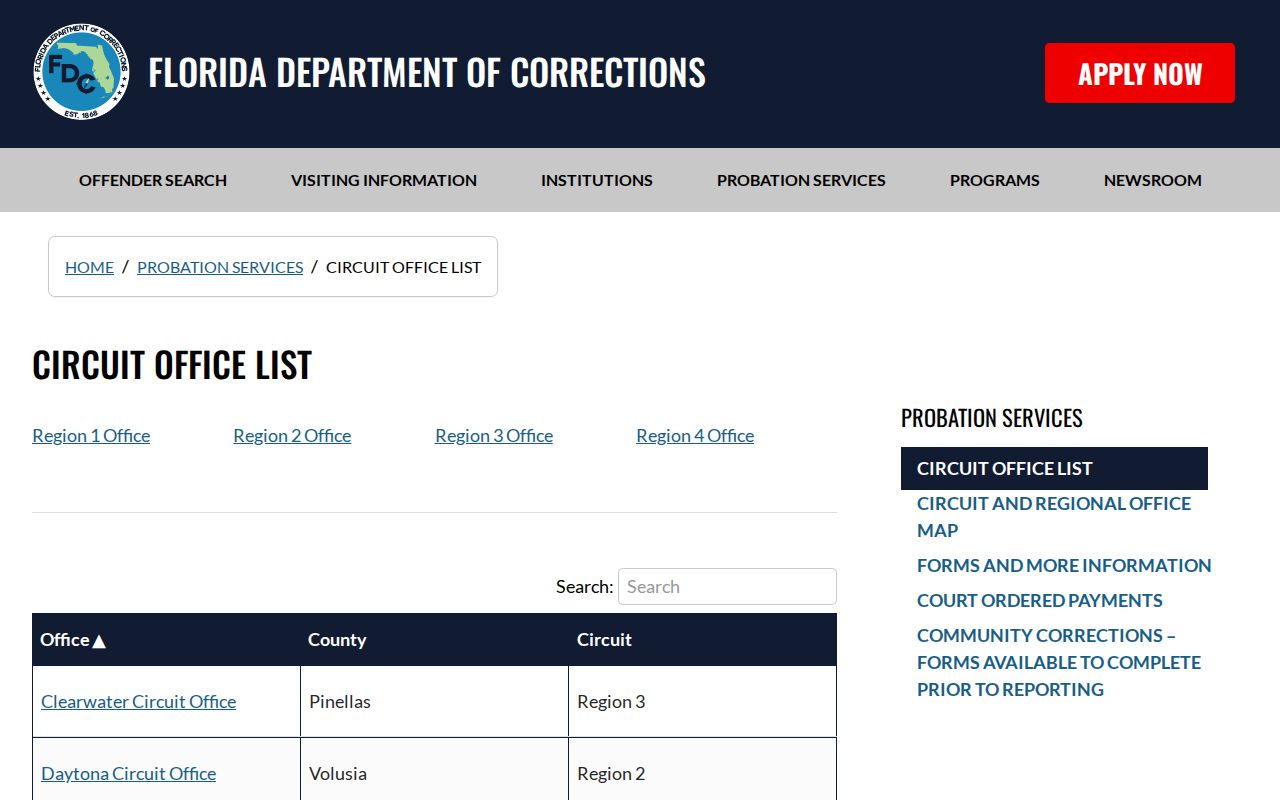
That directory is useful for finding an office, while the individual supervision papers remain the source for where and when a person must report.
Dixie County Absconder Status
An absconder is a person whose whereabouts are reported as unknown after an alleged failure to comply with supervision, with a violation warrant issued under FDC’s definition. Absconder status is not a completed discharge. It is also not the same as ordinary active supervision. Search the FDC absconder database by DC number or carefully matched identity, then verify the date and responsible agency.
Conditions vary with the sentence or commission order. They can address reporting, approved travel, payment, treatment, contact, or other duties, but the public directory does not establish a person’s exact terms. A claimed violation also does not prove that supervision has been revoked. Read the filed violation report, warrant, hearing record, and final order to learn what was alleged and what the responsible authority decided.
The DCSO warrant instructions say local warrant questions are checked by calling or appearing in person. The Sheriff’s Office number for warrant questions is (352) 498-1231. Do not approach the person or attempt to act on a warrant. Public status can change, and a similar name can identify the wrong individual. FDC’s Absconder Unit is available at (850) 717-3475 on weekdays from 8 a.m. to 5 p.m.
- Absconder
- A supervision status indicating unknown whereabouts and a reported violation warrant.
- Violation
- An alleged breach of a supervision condition that must be handled through the lawful process.
- Discharge
- The formal end of supervision, shown by the controlling record or order.
- Active suspense
- Continued monitoring while direct supervision is temporarily interrupted, often by custody elsewhere.
Note: A missing FDC result is not proof that supervision ended; confirm the DC number, court record, and responsible office.
Dixie County Supervision Discharge Records
Supervision ends through a lawful discharge, termination, expiration, or other final action shown in the controlling records. A projected end date is not always the completed end. A violation, amended order, or new custody event can affect the course of the supervision episode. For probation, check the Dixie County court docket for a termination or discharge order and compare it with FDC’s supervision history when FDC was the supervising agency.
For parole or another FCOR matter, obtain the final Commission order and then review FDC’s reported end date and status. Keep distinct dates separate: release from prison, start of supervision, scheduled supervision end, and actual discharge. When an online record is unclear, ask for the exact final order rather than relying on a blank search result or an old calendar entry.
Dixie County Parole Hearing Records
Florida parole is largely a legacy path. FCOR explains that sentencing guidelines effectively abolished parole for most crimes committed on or after October 1, 1983, subject to specified exceptions tied to offense dates and categories. A long sentence does not by itself make someone parole eligible. Section 947.16 of the Florida Statutes controls initial-interview timing for eligible cases, and the precise offense-date category must be checked.
The FCOR live hearing schedule lists dates, meeting types, times, locations or video designations, and detailed case lists. In-person parole hearings normally occur on Wednesdays at 9 a.m., but the calendar also includes teleconferences and occasional Thursday dates. A calendar entry is notice of a proceeding. It is not proof of parole or release.
The official FCOR schedule shows the published hearing and voting calendar used for Dixie County parole record research.
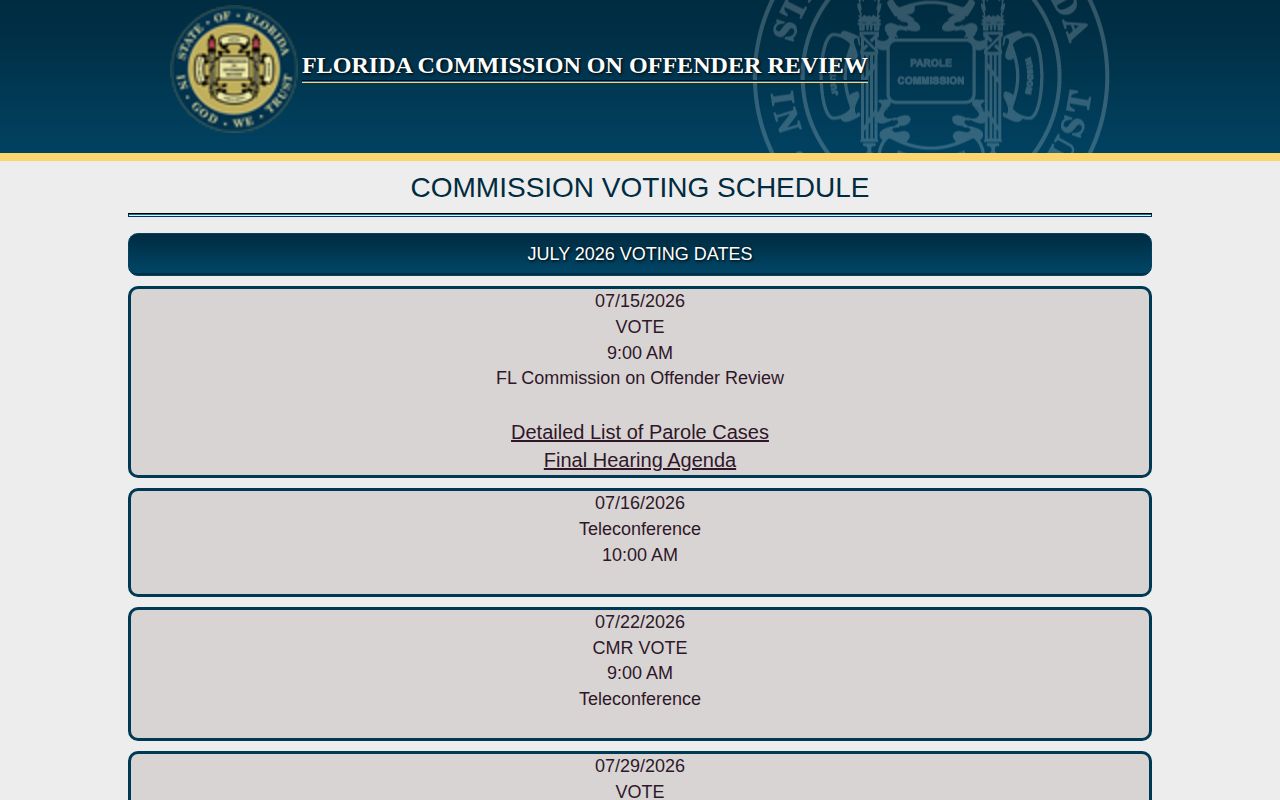
Read the date-specific entry because meeting type and case category can vary. FCOR matters may set, affirm, or modify a presumptive parole release date, delay an effective date, review supervision, or address revocation. “Granted” and “denied” do not capture every possible outcome.
Obtain Dixie County Parole Orders
No current public person-level post-vote decisions database was found. The hearing schedule and case agenda are not final decisions. FCOR’s clemency certificate search is a different system and should not be used as a parole-results substitute. Request the written order with the person’s name, DC number, hearing date, Dixie County, and case number through the FCOR public-records process.
FCOR publishes fcorlegal@fcor.state.fl.us, (850) 848-4460, and Public Records Request, 4070 Esplanade Way, Tallahassee, FL 32399-2450. The agency may invoice copy charges before processing and gives no guaranteed turnaround. Ask for the final order, not merely the agenda.
The official FCOR request page is the documented fallback when a final Dixie County parole decision cannot be confirmed online.
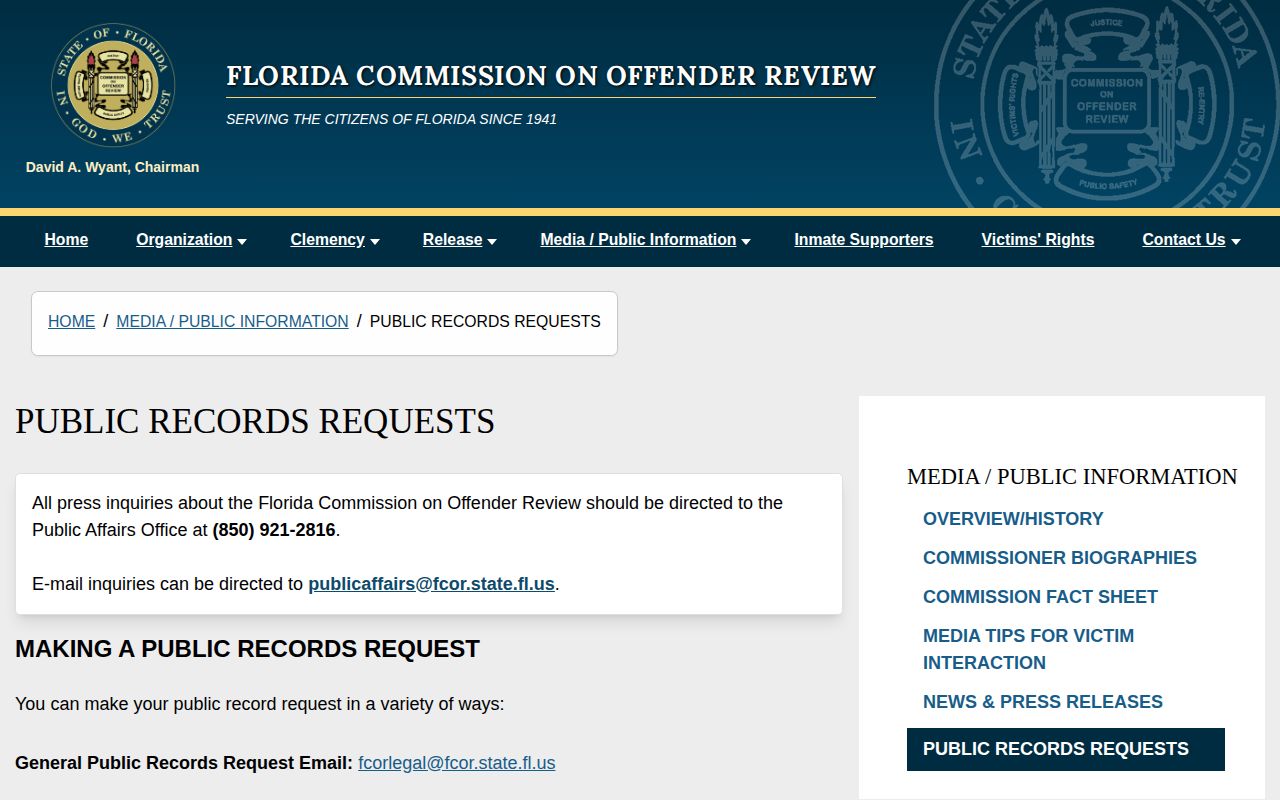
The returned order should be read with the FDC supervision history. One records the decision; the other shows how FDC reported the supervision episode.
Dixie County Release Transition Program
Cross City Correctional Institution provides a local state-prison transition layer. Its official FDC facility page lists a 100-hour Transition Program along with other institutional programs. The listing confirms that the program exists. It does not establish that a particular person qualifies, enrolled, completed it, or received a certain service.
Program participation is also separate from legal supervision. A person may complete transition work and then begin probation, parole, or conditional release. Another person may leave prison without an FDC supervision term. Use the FDC record and controlling order for status. Contact the institution or assigned officer for person-specific transition instructions.
Dixie County Release IDs and Property
Florida law directs FDC and partner agencies to help certain Florida-born inmates obtain core identity documents before sentence-expiration release. Under section 944.605(7), qualifying people may receive a certified birth certificate and state identification and assistance with a Social Security card. Statutory exceptions apply, including some detainers and release circumstances.
Identity-document support does not show whether parole or probation is active. It addresses practical release needs. Florida’s GS2 schedule separately identifies receipts for money or property returned at release and transfer orders as incarceration records. If a Dixie County release packet or property return is disputed, request the specific receipt or transfer record from the agency that held the person.