
Cross City Work Camp Departures
FDC lists Cross City Work Camp as a satellite of Cross City Correctional Institution. The camp has no separate public release database. Its residents remain in Florida state custody, so movement back to the main institution or onward to another FDC unit is a transfer. A location change can be real and important without being release into the community.
A completed release can lead to freedom without supervision or to an FDC community-supervision phase. Read the incarceration and supervision histories together. The first shows when a prison episode ended. The second may show probation, parole, conditional release, control release, or another status. Neither DCSO SmartWEB nor a Dixie County jail call can certify this state event.
Search Work Camp Release Records
The correct public route is the FDC Inmate Release Information Search. Search by the six-character DC number when possible. A name search is prefix based and may return more than one person, so compare the photograph, physical details, aliases, offenses, and sentence record before opening the history.
Use these steps:
- Enter the DC number, or search the full legal name and aliases.
- Open the complete FDC detail and confirm identity.
- Compare current status or location with the “Current Release Date” and incarceration history.
- Look for a Date Out-Custody tied to the correct episode.
- Open the supervision record to see whether state oversight continued.
The release database contains both past releases and scheduled releases. It is updated nightly. A future date is not proof that gate processing occurred. If fields conflict, contact the Bureau of Admission and Release rather than guessing from the work camp's absence in one field.
Work Camp Record Meanings
FDC uses one offender record across institutions. That is helpful because a person may have moved through several units. It also means the work camp name may appear as one location in a longer chronology. Read the episode as a sequence, not as an isolated facility label.
| Record signal | Supported conclusion |
|---|---|
| Work Camp to Cross City CI | Transfer within the parent complex |
| Work Camp to another FDC unit | State custody continues |
| Future Current Release Date | Scheduled agency date, subject to change |
| Date Out-Custody | Historic end of the listed prison episode |
| Active supervision entry | Prison ended but FDC oversight continues |
A released record can retain an old custody classification. That historic label should not override the current status and dated history.
Cross City Work Camp Contact
The parent institution is the published contact because FDC does not list a separate release office for the camp. Use the DC number in a call or message. Ask about the correct FDC unit and release-record route, not county booking information.
Cross City Work Camp
Satellite of Cross City Correctional Institution
568 NE
255th Street
Cross City, FL 32628
Parent phone:
(352) 498-4444
Operator: Florida
Department of Corrections
The research does not support a distinct street address, direct line, release desk, or public hours for the work camp. Those details are not inferred. FDC's Bureau of Admission and Release can address a disputed discharge at (850) 488-9167 or dc.release@fdc.myflorida.com. The central records contact is (850) 488-9859.
Cross City Work Camp Capacity
The official Cross City CI parent page lists the work camp and gives its official capacity. That figure describes the unit, not how many people are there today or how many were released during a year.
The FDC image below shows the parent listing used to verify the satellite relationship and capacity.
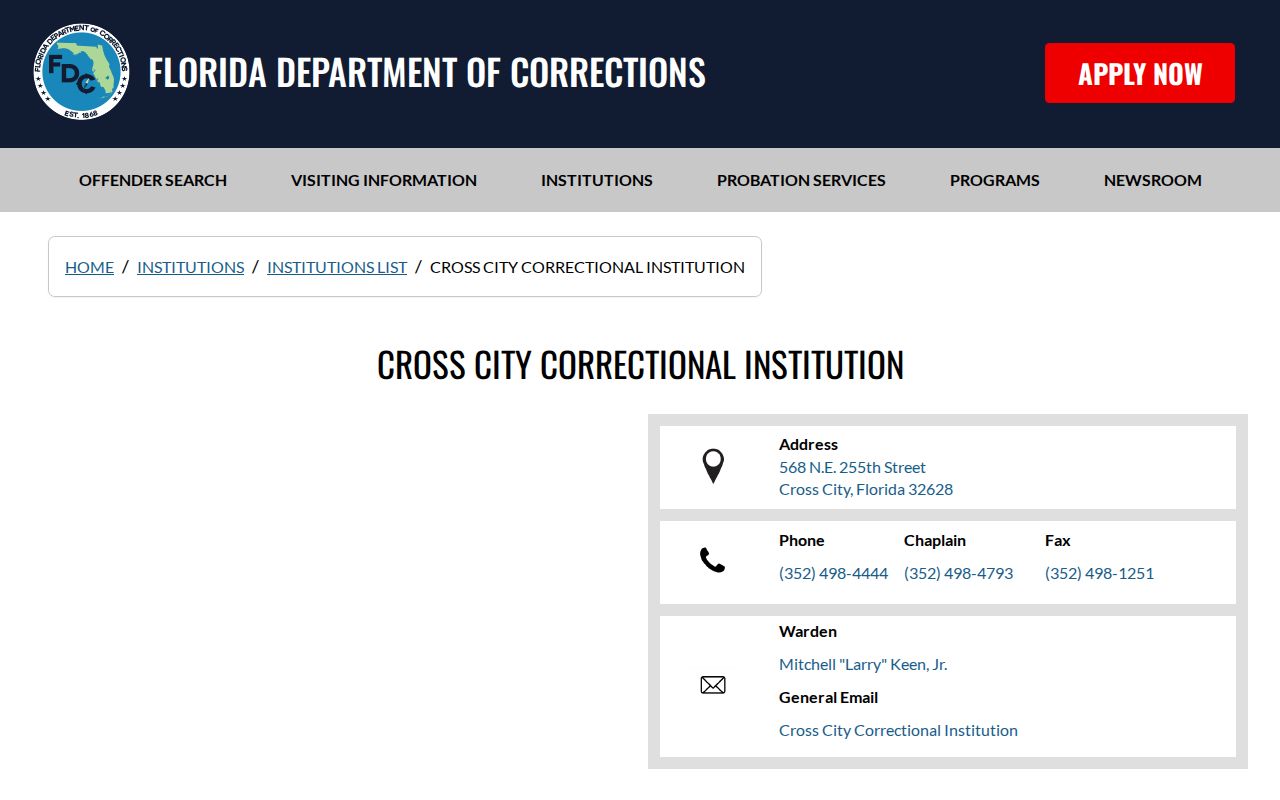
Because the image is a facility source, it does not prove any individual's current location or release.
Neighboring Dixie Release Systems
Cross City Work Camp and Dixie County Jail are both associated with Cross City and NE 255th Street, but they answer to different agencies. The jail is at 386 NE 255th Street and uses DCSO booking and release records. The FDC complex uses 568 NE 255th Street and statewide offender records. Shared geography does not merge the systems.
| Facility | Agency | Release proof |
|---|---|---|
| Cross City Work Camp | FDC | FDC out-custody and supervision history |
| Dixie County Jail | DCSO | County booking/release sheet |
A county booking may lead to a state sentence and transfer to the work camp. That sequence is continued custody until the FDC record shows a state release. The Dixie County released-person search path helps identify which agency owns each episode.
Work Camp Records Requests
When the public detail is not enough, use the FDC public-records route. State the DC number, full name, approximate dates, and the specific incarceration or release field needed. A narrow request for the relevant episode is easier to match than a broad request for all inmate records.
Ask for the record that answers the question. An incarceration history may establish dates. A release or discharge record may identify the state endpoint. A supervision record may document the next phase. The parent institution can direct a facility inquiry, but a statewide public-record request is the sound route for a durable agency response.
Work Camp Supervision Check
Physical release does not always end FDC authority. An “ACTIVE” supervision status means active community supervision. “ACTIVE SUSPENSE” means the person is temporarily unavailable for direct supervision, such as when held elsewhere, but remains monitored. “ABSCONDER” carries the narrower FDC meaning of unknown whereabouts with a violation warrant.
These labels should not be collapsed into “released.” Compare the prison endpoint with the supervision start and current status. A later county arrest is a new episode. It does not erase the earlier work-camp history, and the work-camp record does not explain every later local case.
Note: Call FDC when a rapid location or date change has not yet reached the nightly public release database.
Work Camp Date Conflicts
A planned release can change because of a court amendment, detainer, sentence calculation, gain-time award, forfeiture, or review. FDC's date guides follow-up but does not promise a handoff time. When location changes, check whether the new location is another FDC institution.
A past out-custody date is stronger proof for a completed episode. It does not explain a later county arrest, federal hold, or new sentence. Read each episode by agency and date so a transfer is not mislabeled as community release.
Work Camp Database Follow-Up
FDC offers separate searches for release information, current prison population, supervision, and absconders. A work-camp query should begin with the release database when the question concerns discharge, then move to current population if the date or location is unclear. The public release file can contain both completed and scheduled events. That is why the full detail and dated incarceration history matter more than a result-list match.
For records not displayed online, identify the DC number, work-camp affiliation, approximate dates, and exact document or field sought. The statewide public-records channel is the appropriate custodian route. The parent institution's phone can help with facility routing, but no separate public work-camp release office was found. Keeping the request narrow avoids implying that a satellite holds an independent archive.
Supervision can follow the custody endpoint. A person may leave the work camp and report under FDC Community Corrections, while another person may complete all state authority. Check the supervision start, status, and end rather than assuming that prison departure equals final discharge.
The current-population search is a useful second check when the work camp no longer appears. A new state location means continued custody. If no current row appears, examine out-custody and supervision dates before calling FDC. Each database answers one part of the timeline.
Keep the DC number with any saved result and note when it was viewed. The nightly database can change. Direct FDC confirmation is stronger than an undated result when a release is occurring now.
Public Record Search
Sponsored Results