
Dixie County Scheduled Versus Actual Release
A scheduled date is a forward-looking calculation. It may describe when a sentenced person is expected to leave prison after lawful credits and other sentence rules are applied. The actual release date records the custody event after the person leaves that system. Those dates can match, but they answer different questions. A future date is not proof that a gate release occurred. An incarceration history with a Date Out-Custody or a completed county release record is stronger evidence of departure.
Pretrial custody is different. A person at the Dixie County Jail may leave after bond, dismissal, a court order, or another lawful event, but there may be no sentence from which to compute a fixed date. Another case, warrant, detainer, or transfer can prevent community release. For a county sentence, use the judgment, jail credit, and DCSO’s release record. Do not apply state-prison gain-time rules to a Dixie County jail stay.
Search Dixie County Inmate Release Dates
The correct route depends on who has custody. FDC Offender Search is the main public source for a person serving a Florida state-prison sentence or scheduled for state release. It is not the Dixie County jail roster. DCSO handles its own booking and release record, while the Dixie County Clerk holds court orders and sentence documents. A transfer from the jail to Cross City Correctional Institution is continued custody, not community release.
- Identify the custodian: Dixie County Jail, FDC, another state, or a federal agency.
- For an FDC prisoner, open the Inmate Release Information Search and use the six-character DC number for the cleanest match.
- Open the full detail. Compare current location or status, Current Release Date, sentence history, and incarceration dates.
- For a Dixie County jail sentence or pretrial case, check the judgment and docket, then call Jail Control at (352) 498-1231 ext. 221 or request the DCSO release record.
- If records conflict, contact the responsible records office. FDC’s Bureau of Admission and Release is (850) 488-9167 and dc.release@fdc.myflorida.com.
The Dixie County released inmate search covers the full county-jail record and court-confirmation route. The state search accepts last name, first name, DC number, and alias options. Name matching is prefix based, so longer surnames can appear in a shorter surname search. Compare identity details rather than assuming a matching name is the right person.
| Field | What to check |
|---|---|
| DC number | Exact six-character FDC identifier |
| Current location/status | Whether FDC reports prison, supervision, or an out-custody history |
| Current Release Date | FDC’s displayed future or completed date label |
| Incarceration history | Dates in and out of FDC custody for each episode |
| Sentence detail | Offense, county, case, term, and sentence structure |
The official FDC search screen shows the name and DC-number route used for a Dixie County state-prison release lookup.
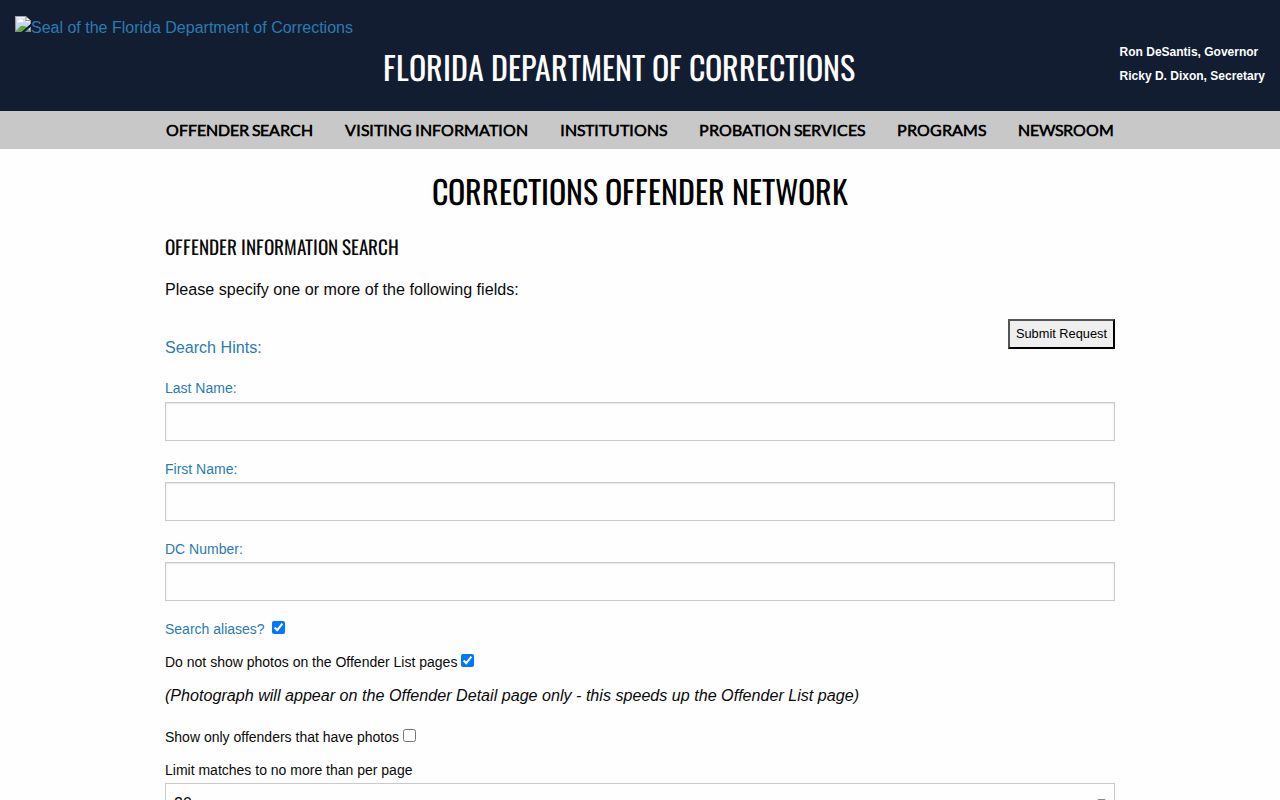
The result list is only the first step. Open the detail and read the date with the custody and sentence histories.
Dixie County Release Date Labels
Florida uses two exact terms. Section 944.275 calls the calculation a tentative release date. The current public FDC offender detail labels the value Current Release Date. Preserve both terms. Calling either one a guaranteed release day would erase the warning built into the official record.
FDC states that its release database contains people already released and people scheduled for release. It is updated nightly. The inmate-population database is generally weekly, while release dates and location changes are updated nightly. That makes the dedicated release-information search the better starting point for this question. Still, a date can change between updates.
The official scheduled-release example displays the exact Current Release Date label and the warning that calculation review can alter it.
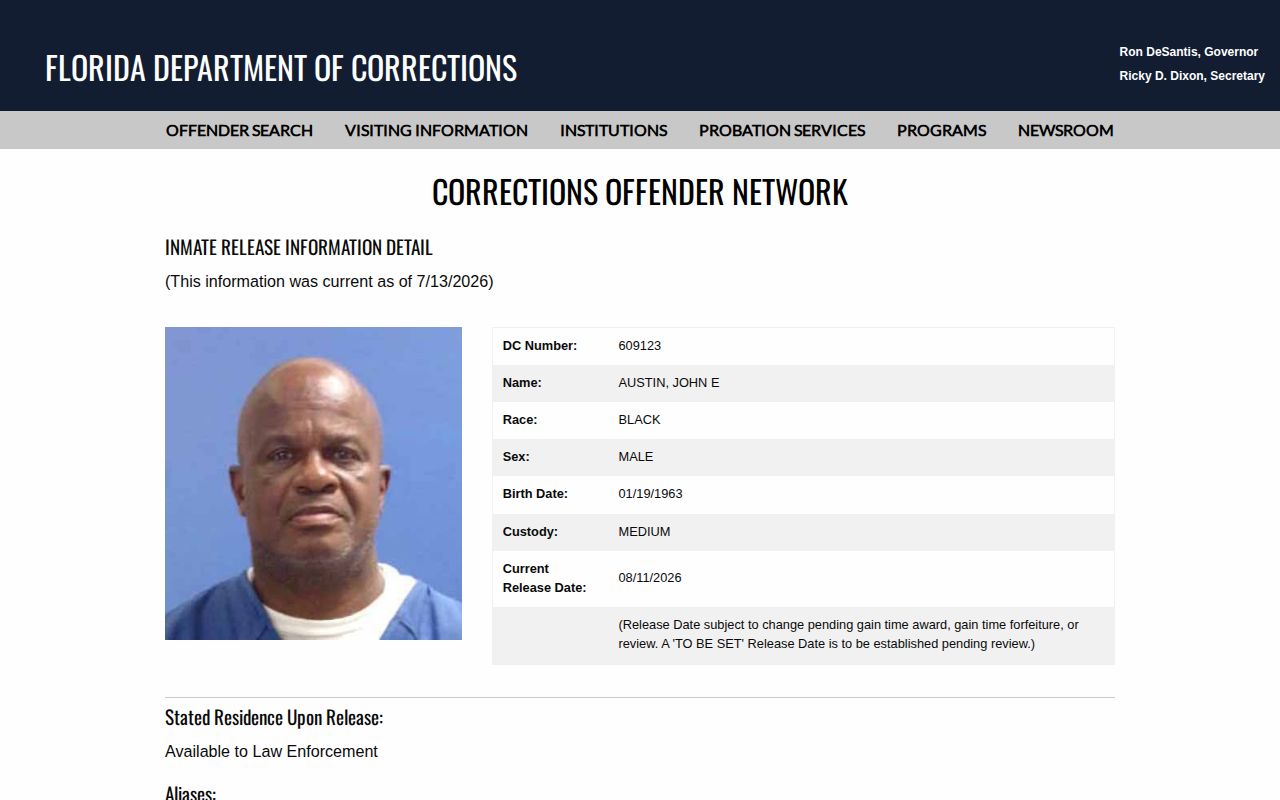
“TO BE SET” means review is pending. It is not a missing date that should be estimated from the sentence length.
Dixie County State Gain-Time Rules
Florida Statutes section 944.275 distinguishes maximum sentence expiration from tentative release. Maximum expiration is the end of the imposed term or terms after lawful custody credit. The tentative date projects eligible gain-time awards and forfeitures. Awarded or restored gain-time can move the date earlier. Forfeited gain-time can move it later. The tentative date cannot extend beyond maximum expiration.
Offense date controls the gain-time framework. Basic gain-time of ten days per month applies to offenses from July 1, 1978 through December 31, 1993. Pre-1994 incentive gain-time can reach twenty days per month. For offenses from January 1, 1994 through September 30, 1995, the former severity level controlled ceilings of twenty or twenty-five days per month. For offenses on or after October 1, 1995, up to ten days per month of incentive gain-time may be granted. Meritorious and eligible educational awards have separate limits. These are statutory ceilings and discretionary awards, not automatic deductions.
Certain homicide, kidnapping, sexual-offense, and related convictions are not eligible for incentive gain-time, with wording that also depends on the offense date. Multiple sentences, mandatory minimums, retained jurisdiction, escape time, parole violations, detainers, and later court action can change the calculation. Never publish a hand calculation as FDC’s official Dixie County release date.
The official gain-time statute is shown in the manifest image used to verify the tentative-date terms and modern minimum-service rule.
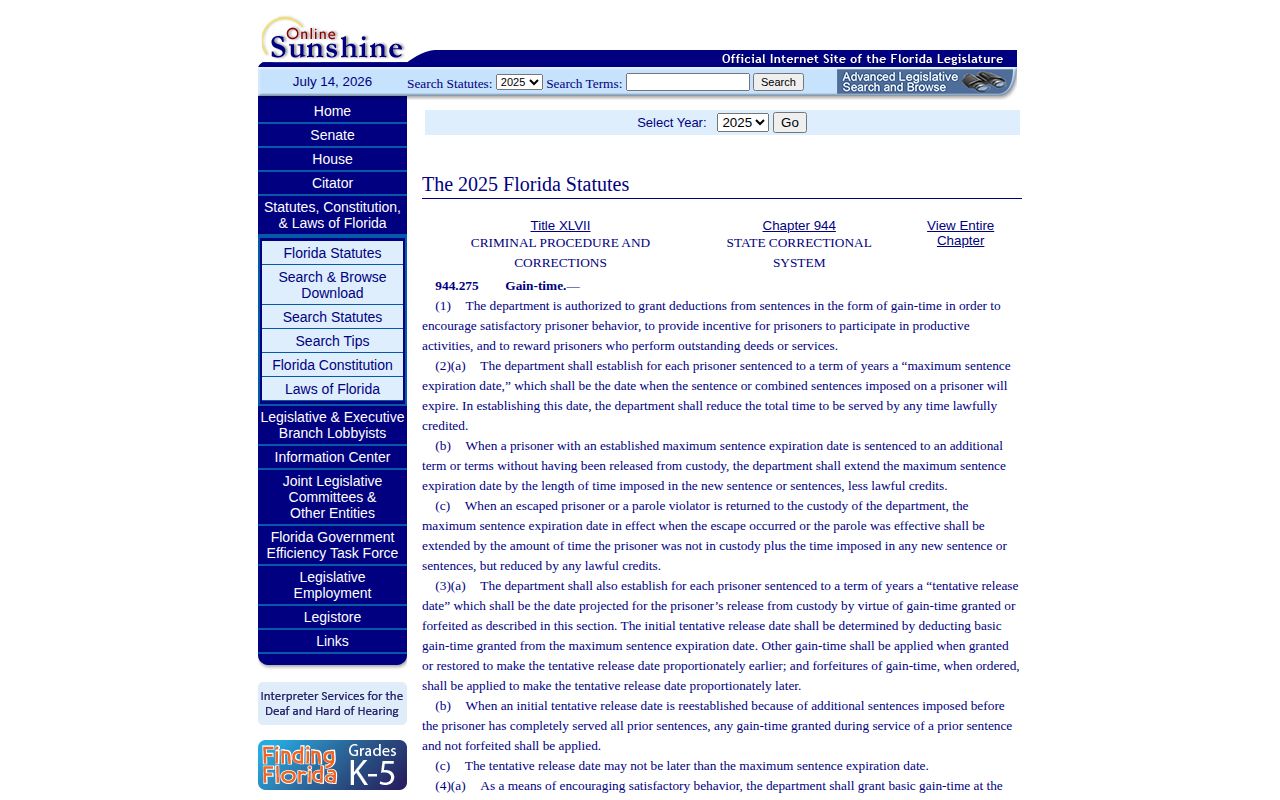
The statute supplies the framework. FDC applies it to the full sentence and custody record that may not be visible in one public screen.
Dixie County Release Eighty-Five Percent Rule
Under section 944.275(4)(f), a person in the post-October 1, 1995 incentive framework cannot receive gain-time that causes release before at least 85 percent of the imposed sentence has been served. Court-awarded credit for time physically incarcerated counts toward that floor. Once the tentative date reaches the 85-percent point, more gain-time generally cannot move the date earlier. A life-sentenced prisoner remains for life absent pardon or clemency.
A safe way to understand the order is: begin with maximum expiration after lawful custody credit, apply only gain-time allowed by the offense date and conviction, move the date for awards or forfeitures, then apply the modern minimum. This explanation does not produce an official date. The public FDC value and Bureau of Admission and Release remain the authoritative calculation channels.
Note: The 85-percent rule is a state-prison sentence rule and must not be copied onto a Dixie County Jail stay.
Dixie County Jail Release Date Records
Dixie County Jail does not publish a local good-time formula or a public projected-date field. Its SmartWEB arrest search has name and booking-date controls. The default “BOOKED Last 24 Hours” view identifies recent entries, not scheduled departures. A pretrial detainee’s next court event, a posted bond amount, or an order authorizing release may help explain what could happen, but none alone proves the person left the facility.
For a county sentence, obtain the judgment and sentence from the Dixie County Clerk, including any credit for time served. Then ask DCSO for the booking/release sheet or jail-management release record. A focused request should identify the full name, date of birth or booking number, booking date, release date and time, release method, and any receiving agency. If the person was sent to FDC, the county departure is a transfer. It is not a community release date.
Jail Control is open around the clock at (352) 498-1231 ext. 221 for person-specific jail information. The DCSO Records Division accepts written requests in person at 214 NE 351 Highway, Suite L, Cross City, or by mail at PO Box 470, Cross City, FL 32628. DCSO publishes no guaranteed turnaround or local copy-price schedule, so request an estimate when the record search may be extensive.
Why Dixie County Release Dates Change
The official date can move for reasons that are not visible in a simple search result. Some affect the sentence calculation. Others affect whether the person can leave to the community on that day. Read each factor against the current court and agency record.
| Factor | Possible effect | Record to confirm |
|---|---|---|
| Gain-time award or restoration | May move an eligible tentative date earlier | FDC calculation and sentence history |
| Gain-time forfeiture | May move the date later | FDC disciplinary and release calculation |
| Jail or prison credit | Changes time remaining on the imposed term | Judgment, amended order, and FDC calculation |
| New or amended sentence | Can require recalculation | Court order and FDC sentence record |
| Detainer or hold | May cause transfer or continued custody elsewhere | Holding and receiving agency records |
| Parole or conditional release | May begin supervision instead of ending the legal sentence | FCOR/FDC order and supervision history |
Florida law also allows qualifying people to begin conditional-release supervision at a tentative or provisional date. Section 947.1405 addresses that post-prison supervision. Leaving the institution can therefore mark a change from custody to supervision, not the end of all legal obligations.
The official conditional-release statute image documents why a Dixie County state-prison release date may lead directly into supervision.
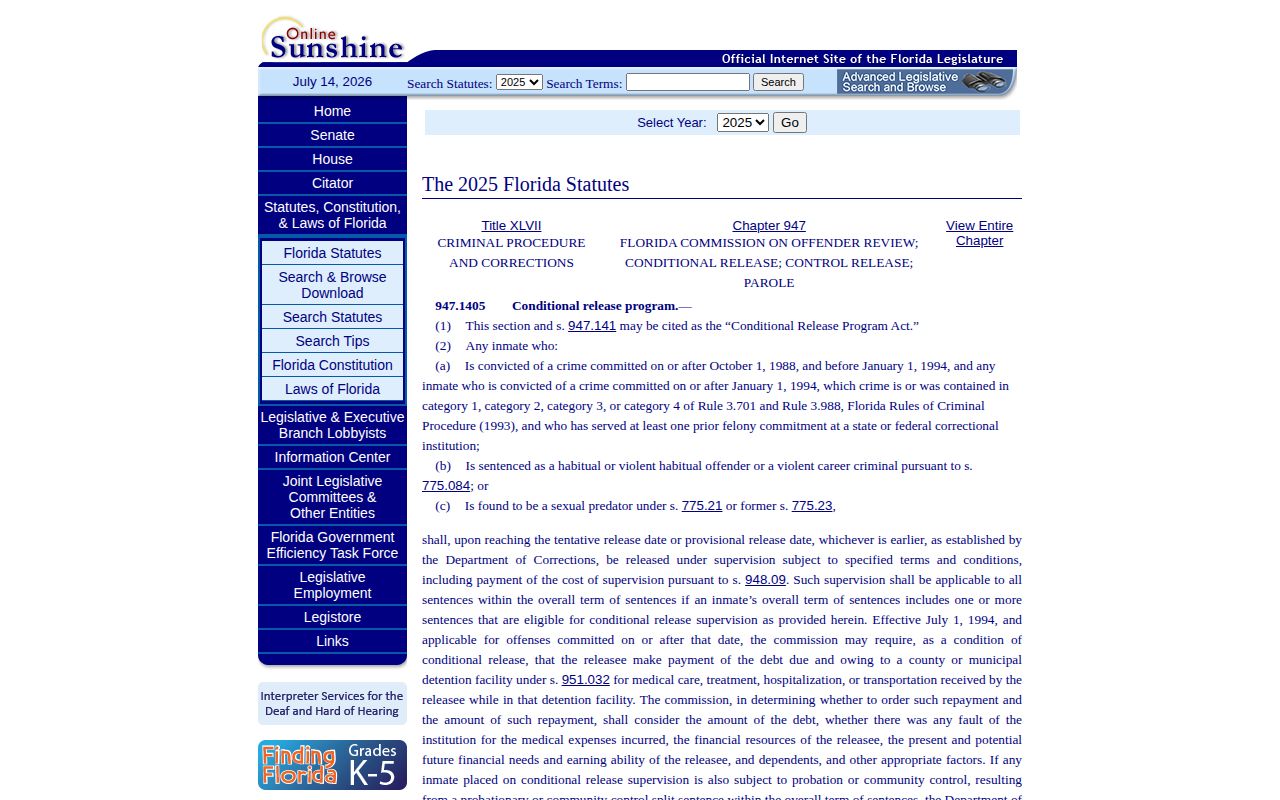
Check the supervision history after the out-custody event so the release and post-release phases are not confused.
Confirm Dixie County Actual Release
For an FDC prisoner, compare the Current Release Date with current location, status, and the incarceration history. When the date remains disputed or an update is pending, contact the Bureau of Admission and Release rather than inferring from the sentence. For a Dixie County detainee, call Jail Control and request the booking/release sheet if written proof is needed. The clerk’s judgment and docket explain the court action but may not prove the exact moment the jail released or transferred the person. Agency context controls each date.
Florida VINE may provide a tentative date and can send a prospective custody-event alert, subject to reporting lag. An alert must be read by event name because transfer, return to custody, work release, and final release are distinct events. The Dixie County VINELink release check explains the one-person search and notification path. After an alert, confirm with FDC, DCSO, or the receiving agency.
- Tentative release date
- The statutory sentence-calculation term used in section 944.275.
- Current Release Date
- The exact label on a present FDC offender detail.
- Actual release
- The completed departure recorded in the custody history or agency release record.
- Detainer
- A hold or request from another authority that can lead to transfer or continued custody.