
Cross City CI Release Paths
Cross City Correctional Institution is an adult male prison operated by the Florida Department of Corrections. A completed state sentence may end with release without supervision, or the person may enter probation, parole, conditional release, control release, or another state supervision status. Each outcome has its own record. FDC's incarceration history can show the end of physical custody, while the supervision view can show whether state oversight continues in the community.
Movement to Cross City Work Camp, Cross City East Unit, or any other FDC institution is not release. FDC may change the location field as it manages custody. Read the current location or status alongside the dates in the incarceration history. A future-looking release date also is not proof that gate processing has occurred. For a past discharge, the out-custody entry is the stronger field.
Search Cross City Release Records
Start with the FDC Inmate Release Information Search. A six-character DC number is the best exact key. If it is unknown, search by last and first name, use the alias option when appropriate, and compare the result's identity fields. The name search is prefix based, which can return longer surnames that begin with the letters entered.
Follow a short, repeatable process:
- Enter the DC number, or search the full name and compare photograph and physical details carefully.
- Open the full offender detail rather than relying on the result list.
- Read current location or status, “Current Release Date” or “Release Date,” and incarceration history together.
- Check the supervision view if the physical custody record shows release.
- Contact FDC's Bureau of Admission and Release when fast-changing fields conflict.
The FDC release database includes people already released and people scheduled for release, and it is updated nightly. A returned name does not prove a completed release. The displayed date must be compared with the date out of custody and the current status.
Cross City Release Field Guide
FDC details vary with the sentence and record. Some show a photograph, aliases, offense and sentence data, incarceration events, and community supervision history. Preserve FDC's exact labels. “Current Release Date” is a dynamic agency field, not a guaranteed pickup time. An old custody-classification label on a released record also does not, by itself, mean the person remains confined.
| FDC field | How to read it |
|---|---|
| DC number | Best identifier for the state record |
| Current location/status | Present FDC placement or status, subject to update lag |
| Current Release Date | Agency date that may change before release |
| Date Out-Custody | Historic endpoint for an incarceration episode |
| Supervision history | Whether state oversight followed prison custody |
If the record only shows a scheduled date, call before making travel plans. Gain-time decisions, court amendments, detainers, and other lawful calculations can alter the date.
Cross City Institution Contact
The institution can address a facility-specific question, while FDC central offices own statewide release and public-record functions. Use the DC number in any call or written request. It is far more precise than a name alone.
Cross City Correctional Institution
568 NE 255th Street
Cross City, FL 32628
Phone:
(352) 498-4444
Email:
CrossCityCI.WardenOffice@fdc.myflorida.com
Operator:
Florida Department of Corrections
FDC lists Mitchell “Larry” Keen Jr. as warden in the facility source reviewed. For a disputed release date or discharge, the Bureau of Admission and Release is the better route at (850) 488-9167 or dc.release@fdc.myflorida.com. For records not online, use the FDC public-records channel and identify the DC number and incarceration episode.
Cross City CI Capacity
The official Cross City CI page identifies the main institution, its satellites, contact details, and programs. It lists an official main-institution capacity of 1,022 and a separate work-camp capacity.
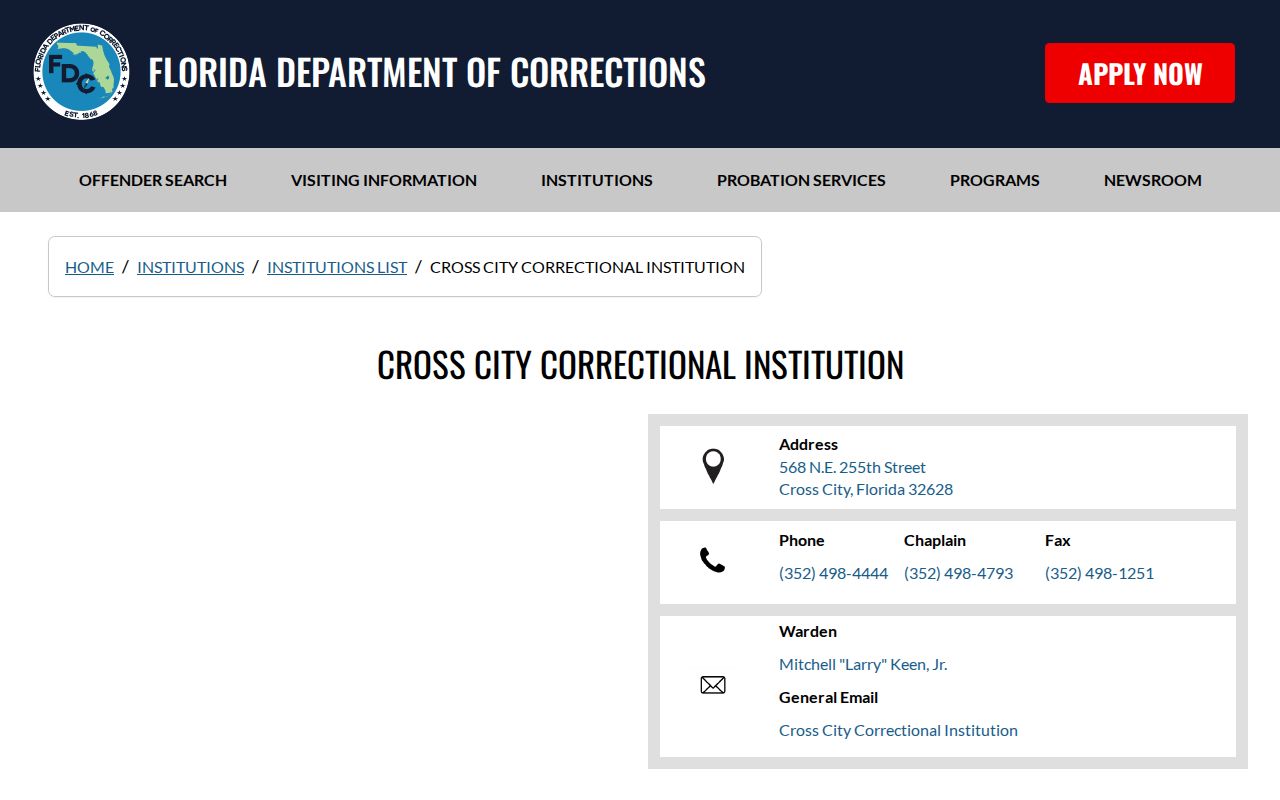
The source image below records how FDC presents the parent facility and its satellites.
The capacity is an institutional design figure, not a current population or annual release count. The program listing likewise does not show that any named person enrolled or completed a course.
Cross City Transition Program
FDC lists a 100-hour Transition Program and other institutional programs at Cross City CI. This is a real local release-related feature, but it should be read with care. The listing does not promise eligibility, placement, completion, transportation, or a set release result for any individual. Program questions belong with FDC and the person's official plan.
A person who completes prison custody may still have reporting duties under an FDC supervision order. The offender detail should be checked for a supervision entry. FDC Community Corrections, not Dixie County Jail, handles that state path. The statewide search and agency contacts remain the controlling sources.
Cross City Versus County Release
The state prison and county jail sit close together on NE 255th Street. Cross City CI uses 568 NE 255th Street. Dixie County Jail uses 386 NE 255th Street. Their proximity can send a searcher to the wrong database. The operator name is the quickest correction: FDC means state prison; DCSO means county jail.
| Question | Cross City CI | Dixie County Jail |
|---|---|---|
| Custodian | Florida Department of Corrections | Dixie County Sheriff's Office |
| Release search | FDC offender and release databases | DCSO booking/release record |
| Location change | May be an intra-FDC transfer | May be release or transfer |
| Durable endpoint | FDC out-custody history | DCSO release sheet |
A move from the jail into Cross City CI is continued custody. It should never be described as community release. The Dixie County release search overview explains how the county and state routes fit together.
Cross City Supervision After Release
Release from prison and discharge from all state authority are not always the same event. An FDC record may show that incarceration ended while supervision began. “Active” indicates active community supervision. “Active suspense” means direct supervision is temporarily unavailable because the person is in a jail or other facility while still monitored. “Absconder” is a specific status tied to unknown whereabouts and a violation warrant.
Read the supervision record as a separate phase. Do not infer present freedom from the end of a prison row. If no online field resolves the issue, FDC supervision contacts can confirm the correct agency route. A later Dixie County booking is a new custody episode and does not rewrite the earlier state release history.
Note: FDC warns that rapidly changing status, location, and release fields may not reflect the latest event.
FDC central classification can identify the correct incarceration episode when public history needs clarification.
Cross City FDC Database Choice
FDC separates its release information search from current inmate population, supervised population, and absconder searches. The all-databases choice can span those categories, but each result still needs interpretation. A release-search result may concern a person already out or merely scheduled to leave. A supervised result may show a post-prison phase. An absconder record has its own warrant-based meaning. Selecting the specific database and then opening the detail reduces ambiguity.
For an offline record, identify the DC number, Cross City CI, and approximate incarceration dates in the FDC request. Ask for the precise release, incarceration-history, or supervision record needed. FDC central records can address inmate population material, while the Bureau of Admission and Release handles release questions. The institution can route local operational questions, but it does not replace the statewide custodian.
The official parent page also identifies East Unit and the work camp as satellites. That campus structure explains why the public location can change without any community discharge. It also supports checking the full chronology rather than focusing only on the latest institution name.
When a person has several prison terms, match the sentence county, offense, and dates to the correct episode. One old release row cannot prove present status. A later incarceration or supervision entry must be read on its own terms. This date-by-date method matters at a complex where institutional moves are common.
Public Record Search
Sponsored Results